




Why Your Marketing AI Spend Isn’t Paying Off — And How To Fix It
Most companies are spending more on AI than they did a year ago, and most can’t point to what they got for it. The tools are everywhere. The ROI isn’t.
And marketers? We’re an ant under a magnifying glass on a sunny day. If you talk to nearly any CMO, they’re being told to go faster, do more with less, and grow baby, grow.
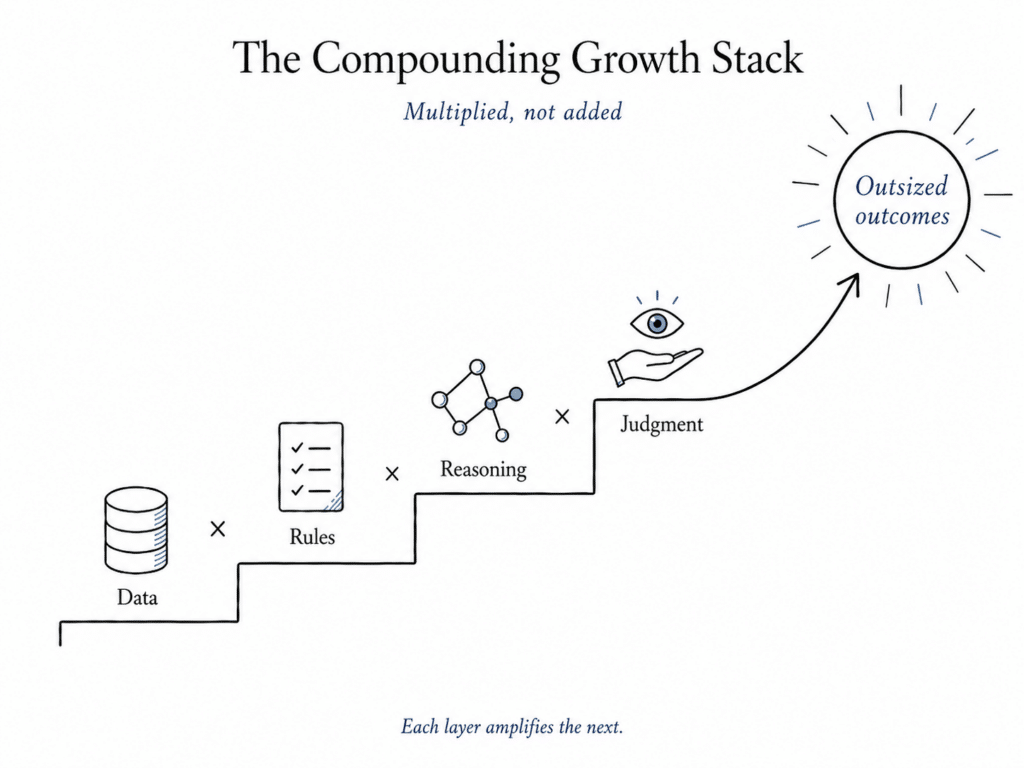
Here’s the part that gets lost in the scramble: the job was never “produce more marketing.” The job is to understand consumers well enough to earn their attention, change their minds, and turn the curious into customers. That’s all marketing has ever been. AI that just does tasks faster is a step in the right direction, but it falls short of the panacea every CEO expects. The marketers pulling real returns are doing something structurally different. They’ve stopped treating AI as a tool you point at a task and started treating it as one layer in a system:
Data × Rules × Reasoning × Judgment
Your data, connected so the AI can actually use it. The rules that encode how you think and decide. The reasoning the AI does across both. And the human judgment to decide what’s worth trusting and doing.
We all know “human in the loop” by now, so yeah, you get that part. But it’s this system, sequentially, connected, that will compound value and drive returns.
I write it with multiplication signs on purpose, because that’s how it behaves: if any one term is near zero, the whole product is near zero. Most companies are running three terms and a blank. A great model with no rules behind it, or rich data nobody’s taught the AI to reason over, and then they wonder why the output is generic (or flat out wrong). The value isn’t in any single piece. It’s in the multiplication. I call the whole thing the Compounding Growth Stack, because each layer is worth dramatically more once the one beneath it is in place, and the returns compound the same way growth does.
This is the playbook for building it, and I’m going to be specific, because the abstract version of this advice is useless. I run product at Cro Metrics, a growth agency, and over the last several months, we’ve wired AI into the actual work: funnel analysis that found opportunities our strategists likely would have overlooked, roadmaps the machine built and scored in an afternoon, the tedious maintenance that quietly bleeds budget, and now just gets done. I’ll show you where it’s genuinely revolutionary and where it confidently produces garbage, because both matter. By the end, you should know all four terms of the stack, why most AI efforts stall when one is missing, and where to start if you want returns instead of tool subscriptions you’re embarrassed to defend.

The four terms, defined
I named the four terms above; here’s what each actually is, because the labels do a lot of quiet work. Your data is web and SEO analytics, customer and transactional records, channel, campaign, and experiment performance, all connected so the AI can interrogate it directly. The rules are the context and decision logic you give the AI so it reasons like you and not like a generic chatbot. The reasoning is what it then does: the analysis, the research, the plans. And the last term, judgment, is the human deciding what to act on, threaded through everything, deciding whether the work is any good. (Execution, the connectors and agents that go act on the plans, is how the reasoning leaves the room; I treat it as part of the same machinery rather than a fifth term.)
Here’s the part most people get backward. They obsess over the first term and the doing — get the data connected, get the agents running — and treat the middle as plumbing. It’s the opposite. Connecting data is table stakes now. The rules and the judgment are the moat, and they’re the two terms most likely to be the blank in your own equation.
The data is easy to connect, and that’s where it gets interesting
Connecting your data to AI used to be a project; now it’s mostly a configuration. We expose analytics, customer data, program and experiment history, and ad platforms through connectors, and the AI can query them directly. Not wait for someone to export a CSV and paste it in, but actually interrogate the source and get an answer back.
Your competitors can wire up the same pipes by next quarter, so the plumbing itself earns you nothing. Don’t confuse “easy to connect” with “not where the value is.” The value is enormous; it just doesn’t live solely in the connection. It lives in what becomes possible once the AI can actually reason over everything at once. Reachable data is table stakes. Reasoning over reachable data is the whole game.
Context makes it relevant. Rules make it good.
Context is facts. Your brand, your ICP, your TAM, your North Star metric, who your competitors actually are, what you sell, and to whom. How buyers discover your product, and what motivates them to buy. You feed the AI context so its output is about your business instead of business in general. This is the easy half, and it’s where most “we gave the AI a brand doc” projects stop. Context gets you relevance. Relevance is not the same as good.
Rules are judgment, written down. Not “here’s our brand” but “here’s how we decide whether a test is worth running.” Not “here’s our data” but “here’s what a result actually means, i.e., when a 2% lift is signal and when it’s noise, which levers tend to move which metrics, what we’ve tried before that looked clever and flopped.” Rules are the opinionated logic an experienced strategist carries in their head and applies without noticing. The entire game is getting that logic out of their head and into a form the AI can reason with.
Here’s what that looks like in practice for us. We’ve classified thousands of experiments we’ve run across clients, industries, and business models by the lever each pulled, the psychological principle behind it, the outcome, and the measured impact. What we’ve actually encoded isn’t a record of what worked, it’s a structured model of why people respond. Which appeals to loss aversion, which to social proof, which to urgency, and for which kind of buyer, in which context, at which step of their journey. That’s not a content library. It’s an account of how real consumers decide, organized so a machine can reason over it. When the AI works on a new problem, it isn’t free-associating from the open internet. It’s reasoning over a decade of real human behavior, organized by rules we wrote on purpose. That’s the asset. The connectors are replaceable; the encoded judgment is not.
This isn’t a thing you stand up from scratch in a quarter. In our case, it’s the slow residue of having run thousands of tests over years, most of which didn’t work, and of being disciplined enough to classify each one by what it was really testing about human behavior and whether the market actually responded. You can’t prompt your way to it. You can’t shortcut it with a better model, because the model isn’t the scarce part. The scarce part is the accumulated, written-down judgment about how people behave, and the only way to get it is to have done the work and kept score. That’s the moat: not that it’s valuable, but that it’s slow, cumulative, and nearly impossible to start from zero. Anyone can buy the same connectors. Nobody can buy the years of being right and wrong that taught you which results to trust. If you’re a marketing leader wondering where to actually invest, it’s here. Write down what good looks like. That’s the work.
What it unlocks: it finds the thing you’d have missed
Now the layers start compounding.
Start with discovery, because it’s the part that genuinely wowed me. We had an account where we connected web analytics directly to Claude, gave it rules and definitions about those analytics, and asked it to do something a person could do but realistically never would, not at this depth: walk the entire customer journey, step by step, and tell us where the real leverage was. Not a dashboard summary, an actual analysis of where people were dropping out, and what kind of person, and what it was worth to win them back. It surfaced a specific moment of hesitation, for a specific kind of visitor arriving from a specific source, that wasn’t the obvious place anyone had been looking. Then we cross-referenced that moment against our own testing history — against everything we knew about how that kind of person tends to respond — and found we’d never systematically gone after that combination, that visitor, that point in their journey. We were in a tightly defined zone of high-value experiments that, honestly, a strategist might never have wandered into. Not because they aren’t good. Because no one has the hours to interrogate a full journey that exhaustively against a decade of prior behavior, and so you go where instinct and the last few wins point you.
It’s worth naming the mind-blown moment exactly: it came when we combined the client’s analytics, the consumer’s profile, what we knew of their journey, and our testing database, and AI reasoned across all of it at once. None of those pieces alone is new.
The story everyone tells about AI is that it does your work faster. The more interesting story is that it does work you wouldn’t have done at all — reasoning over more data, more exhaustively, than is rational for a human to attempt, and occasionally handing you that door. The connectors aren’t just a speed-up. They’re what let the AI see the whole board, and the whole board is a person moving through a journey.
And once you trust it to find the opening, you can hand it the next job too: building the plan to exploit it.
We have another client, a national retail-services brand with hundreds of locations and aggressive growth, facing a hard revenue-impact goal and not nearly enough quarters to hit it the old way. The old way being: a strategist sits down, pulls what history they can, leans on experience and instinct, and hand-builds a roadmap. It’s good work. It’s also slow, and it can only hold so much in view at once.
Instead, the AI ingested that account’s entire test history, set it against patterns from comparable accounts, scored every candidate experiment for projected impact and for how quickly it could ship, and assembled a sequenced roadmap. The modeled impact ceiling went from under $2 million to a projected $25 million-plus in about two months.
I need to be careful with that number, and being careful is the whole point. That’s modeled potential — what the prioritized roadmap projects if the tests perform as the history suggests, not money in the bank. Anyone who tells you AI “drove $25 million” is selling you something. What AI did was build, score, and sequence a plan at a speed and breadth that a human couldn’t match, and surface a credible path that was previously invisible. That’s not a small thing. It’s also not the same as the result, and conflating them is exactly the kind of error the judgment layer is meant to catch.
Because here’s what the AI didn’t do. It didn’t decide which of those tests were real and which were artifacts of thin data. It didn’t re-score against the updated value numbers the client handed us mid-stream. It didn’t decide what the team could actually ship without drowning. A team of humans did all of that, curating, correcting, sequencing against real capacity. The AI generated the plan. The humans owned it. And the most important tell that this is an operating model and not a one-off is that we run the same loop across account after account: ingest the history, reason over it with our rules, produce a prioritized plan, and hand it to humans to judge.
What it unlocks: the loop closes
Strategy is the glamorous half. The other half is the reason most marketing programs quietly leak money, and it’s a lot less sexy: maintenance.
We run paid search for a nonprofit across a large set of campaigns. Every week, search terms accumulate — queries that triggered an ad but had nothing to do with the people who actually want to give. Job-seekers, the geographically confused, people hunting for a competitor. Every one of those clicks is budget spent reaching the wrong person, and they compound. The fix is well understood: review the terms, identify the junk, and add it as negative keywords — which is really just the unglamorous work of keeping spend pointed at the right human instead of the wrong one. The problem is that this review is dull; it’s easy to defer when something on fire needs attention, and so in practice it often just…doesn’t happen. The biggest driver of wasted ad spend isn’t always a bad strategy. It’s maintenance debt, the necessary, boring upkeep that slips.
So our Director of Performance Marketing built a loop. Every week, the AI pulls 60 days of search terms, filters out the ones nobody’s managed yet, classifies each into a theme, and posts a tidy report to Slack for the account lead. He reviews it, and “reviews” means either a single emoji reaction approving it or a plain-language note like “skip the geographic ones.” If he approves, the AI automatically adds the negatives across the entire account. Start to finish: about a day, of which the human spends maybe two to five minutes. The thing it replaced took one to two hours of focused attention and, again, frequently never got done at all.
Notice that the win here isn’t intelligence. The classification is useful, but it’s not the magic. The magic is consistency. A tedious, high-value task that now happens every single week without anyone having to remember it, summon the discipline, or carve out the time. AI’s most underrated contribution to marketing might just be that it does the boring thing reliably.
And notice the design, because it’s deliberate. The AI doesn’t just go change the account on its own. It proposes, a human disposes, with one tap. That’s the right amount of autonomy for this job: high leverage, low risk, fast approval. Other jobs warrant a tighter leash, and a few warrant a looser one. Matching the degree of autonomy to the task’s stakes is most of the art. I’m wary of anyone promising fully autonomous marketing; the interesting systems keep a human exactly where their judgment is most valuable.
The part that keeps it honest
AI pointed at real data still produces confident, fluent garbage on a regular basis. It builds roadmaps that over-index on whatever’s easiest to measure. It confidently misinterprets the analytics. Or, worse, the analytics weren’t configured correctly in the first place. It hands you a projection and lets you mistake it for an outcome if you’re not paying attention. It misses the context a good operator carries that never made it into the rules: the client politics, the brand sensitivity, the thing everyone on the account just knows about how their customer actually behaves. It’s a wildly confident, phenomenally fast analyst and strategist who has never once been embarrassed by being wrong.
Which is why the human-in-the-loop isn’t a transitional phase we’ll engineer away once the models get better. It’s the architecture. As the doing gets automated, the job doesn’t disappear; it moves up a level, from producing the work to judging it. The skill that’s now scarce and valuable isn’t “can you build the roadmap.” It’s “can you look at a roadmap the machine built in nine seconds and know which parts to steer and trust.” That’s a harder skill, not an easier one, and the marketers who develop it will be worth a great deal.
So how do you build this?
If you take one thing from this, don’t let it be a tool to go buy. Let it be an order of operations.
Get your data reachable. Necessary, unglamorous, do it first, don’t mistake it for progress. Connectors are the cost of entry, not the edge.
Then invest in the rules. This is the real work and the part with your name on it. Write down what good looks like: how you decide, how you read a result, what you’ve learned the hard way about how your customers behave. That’s what turns generic AI output into your judgment at scale, and it’s the one layer a competitor can’t simply purchase. (And guess what, once you have it, you can use AI to train AI.)
Prove the loop on something boring. Find a high-value task that suffers from maintenance debt. The review that always slips, the upkeep nobody has time for, and close the loop on it with a human approving the last step. It builds trust, it banks a real win, and it teaches you how much autonomy you’re actually comfortable giving.
Then move up the stack. Once the plumbing works and the rules are real and you trust the loop, point the same system at strategy. That’s where the compounding is. The loop reinforces itself.
And keep your hand on it. Not because the AI is dangerous, but because your judgment is the product now. The whole point of automating the doing is to free you up for the deciding. Don’t automate that part away, too.
That’s the Compounding Growth Stack: data, rules, reasoning, judgment — multiplied, not added. But none of it is the point in itself. The point is the person on the other end — understanding their journey well enough to show up at the right moment with the right thing, at a scale and consistency no one could manage by hand. The marketers who win the next few years won’t be the ones with the best models. Everyone will have the same models. They’ll be the ones who connected the data, did the patient and unsexy work of teaching the machine how their customers actually behave, kept the wisdom to overrule it — and never lost sight of the human all that machinery is for. Get one term right, and you get a party trick. Get all four right, and you get an operating model. Keep the consumer at the center, and you get growth.
Reach out to me on LinkedIn if you ever want to geek out about Compounding Growth Stacks, AI-driven marketing, or the connected consumer journey.
Ready to turn ambitious growth goals into deeper customer connections and measurable business impact?
Reach Out Today