




Cro Metrics × Kameleoon | October 2026
Executive summary
Think about the last good experiment your team wanted to run but could not get built. Maybe it needed a developer already committed elsewhere. Perhaps a small change did not feel worth another handoff. Over time, those decisions shape your program: which questions get answered, which ideas stay in the backlog, and how quickly your team can respond to what it learns.
Kameleoon’s Prompt-Based Experimentation (PBX) opens another path. Describe a change, see a working variation on your website, and refine it through conversation. In our sessions, practitioners built changes that surprised them, saw new ways to bring stakeholders into an idea, and started reconsidering how their own programs worked.
Their experiences point to an opportunity that reaches beyond the build. More people can take an active role in creating variations. Promising ideas can become tangible earlier. Specialist time can go toward harder problems. With a few deliberate changes to review and approval, teams can put that new capacity to work.
The question for your program is practical: what would you do differently if more of your best ideas were within reach? This guide starts with what practitioners experienced, then shows how to choose an entry point, rethink the workflow, and try PBX on an experiment that matters to you.
How we approached the study
Cro Metrics held more than ten exploratory conversations with practitioners, strategists, engineers, program managers, and platform buyers across several industries. Where sites permitted, participants built real variations in PBX. Findings are qualitative and cover previews and partial configuration; we did not measure actual production launches, average time savings, or conversion impact. Quotes are anonymized. Workflow recommendations are Cro Metrics’ interpretation of the findings. We identified current product capabilities through linked documentation, which may differ from those available during a session. The study was jointly produced with Kameleoon; findings and analysis are Cro Metrics’.
Industries covered
We spoke to practitioners working across the following industries:
- Non-profit
- National telecom
- Direct-to-Consumer (DTC)
- Automotive Retail
- B2B SaaS
- Consumer subscription
- Performance Marketing services
1 What practitioners accomplished with PBX
One strategist began with a straightforward request: change the CTA copy on a nonprofit donation page. PBX did it in one prompt. Her verdict was simple: “That one was very easy.” Then she decided to see how far she could take it.
The moment an expected limit became a possibility
Her next request was more involved: default a donation modal to monthly giving. The experience involved an iframe and seven donation triggers, followed by a request to open the modal automatically on page load. She expected the tool to struggle. The preview surprised her.
“Oh my God, it did it. Kind of crazy. I was expecting it to get it [wrong].”
Growth strategist · National nonprofit
The variation took two prompts, including a correction along the way. What mattered was that she could describe the change, inspect the result, and keep moving herself. A task she had expected to be difficult was suddenly something she could work through directly.
“It is faster than I thought it would be, to be honest. I thought it would take more time.”
This was a successful preview, with production validation still ahead. It gives teams a reason to explore beyond the simplest edits: start with a clear change, then try a more involved behavior whose outcome you can inspect and review.
An idea people can experience
A strategist working across retail accounts saw another opening. When one or two ideas deserved a closer look, he could use PBX to show stakeholders what the proposed experience would actually feel like on the website.
“If I’m going to invest the time to put together a mockup and hypothesis, let’s just put that same time into building the variation and walking them through that preview link.”
Growth strategist · Retail accounts
That changes the conversation. People can react to the interaction, placement, and flow together. For a shortlist of promising ideas, explaining the concept also starts moving the variation forward. The participant still preferred a lighter approach for a broad round of many ideas; another wanted to refine the preview before presenting it. Prepare the experience you want people to discuss.
A more direct role for the people who own the question
An in-house analyst at an automotive parts retailer described the appeal for a marketing team that depended on outside help to implement tests.
“Whether it’s changing an H1 or different variations of program messaging, that obviously would be very handy to have a tool like this where we didn’t have to use an agency and another third party, or middleman, if you will.”
In-house analyst · Automotive parts retailer
For that team, the attraction was independence. PBX offered the chance to put familiar messaging ideas into motion without arranging a separate build each time. If your backlog contains questions that keep losing out to other implementation priorities, this is a useful place to begin.
2 Where to get value first
Your best starting point is probably already in your backlog. Look for a worthwhile question with a clear proposed change—and a reason it has not moved forward. The most revealing first task will help you learn something about both your website and your way of working.
Start where access changes what is possible
A digital leader at a telecom enterprise described a familiar situation: a manager is accountable for improving part of the funnel but has little capacity to act. His description of what that person needs was direct.
“They need answers, then they need to do something, and they need to show that they have done something.”
Digital leader · Telecom enterprise
For someone in that position, being able to create a variation is a meaningful step toward action. The same is true inside an established program when a good idea repeatedly waits behind larger projects. Begin with the work that matters to you, then choose a scope your team can confidently review.
| If this sounds familiar | Try PBX on | What you can learn |
|---|---|---|
| A useful idea is waiting for build support | A scoped messaging or interface change already on the backlog | Whether the owner can move the variation forward more independently |
| Stakeholders cannot quite picture the proposal | One shortlisted concept with clear design direction | Whether a working preview helps resolve questions earlier |
| Routine changes consume specialist time | A recurring type of variation your practitioners understand | Which builds can become part of their day-to-day work |
| An approved design is waiting for implementation | A variation using the approved design as an input | How much implementation effort the team can recover |
Give the tool the context your team already has
Your designers know how the brand should look. Your engineers know how the site behaves. Your analysts know which audiences and events to trust. Bringing that knowledge into the process makes it easier for others to build well.
Kameleoon’s Master Prompts provide project-level instructions for recurring brand, technical, and data requirements. Importing directly from Figma allows teams to bring approved frames into the build. PBX Configure supports selecting existing segments and goals, helping teams reuse work they have already done. [1–3]
These capabilities give specialists a useful role in setting others up for success. Invest a little preparation in the conventions and assets you expect to use repeatedly, then improve them as the team learns.
Expand from a first success
A clear change to an existing component is often easier to evaluate than a broad redesign. Once the team has reviewed a successful variation, try a related increase in scope. Bring technical support in early for unfamiliar interactions, wider template coverage, or complex personalization. Each reviewed build helps you understand where PBX fits your site and where specialist involvement adds the most value.
3 What changes when building becomes easier
A new build capability invites you to revisit the assumptions underneath your program. Which ideas do you dismiss because they feel too expensive to implement? Which tasks still wait for the next meeting? Which people could contribute more if they could show you a working version of their idea?
Reopen the backlog with a different question
Some experiments were shelved because the effort did not seem justified. Reassess them with PBX in mind. A smaller build commitment may make a useful question practical to answer, particularly when customer evidence and a clear business decision are already there.
Keep prioritization grounded in impact, evidence, traffic, and measurement feasibility. Easier creation gives you more choices. Use that freedom to address questions that have been hard to act on and to follow up on what previous experiments taught you.
Let specialists spend more time where their expertise matters
A retail strategist deliberately chose a harder task for the study because the client could already manage simpler variations in its existing platform.
“They’re [the client] pretty proficient in Optimizely, so if it’s low complexity I’d rather do something a little bit higher, so we can actually be the ones to do that for them.”
Growth strategist · Retail accounts
His instinct is a useful one for agencies and internal teams alike. As practitioners take on suitable builds, specialist capacity can move toward more demanding implementation, better research, clearer measurement, and stronger interpretation. Agree on that division together, then look at where the time actually goes.
Allow ready work to move
The nonprofit strategist quickly connected her build experience to the rhythm of her program. She pictured a variation moving into QA and then going live within the same week.
“If I can just come in here and build it, and two days for QA, and have it live by Wednesday — it’s like, what are we doing? That just makes things move a lot faster and provides a lot more value.”
Growth strategist · National nonprofit
She was imagining a future workflow, but the question is worth asking now. If a variation is ready earlier, can your team review it earlier? Could suitable experiments proceed between planning meetings once the agreed requirements are met? A small change in cadence may help you capture more of the value from an easier build.
Make adaptation a shared commitment
You can start that conversation before expectations change around you. Ask what a good PBX-assisted workflow would look like for the people who own strategy, design, analytics, and delivery. Choose one change to try. Track whether it reduces effort or waiting, and whether the recovered capacity helps more worthwhile experiments reach a decision.
4 The chokepoint map and workflow adaptations
A quicker build makes the rest of your process friction easier to spot. The variation is ready, but the audience still needs defining. QA has no capacity until next week. The approver is waiting for a meeting. Those moments tell you where to make the next improvement.
A digital leader at a telecom enterprise recognized the organizational side immediately.
“There’s more internal inertia around the process of experimentation that has nothing to do with the technology.”
Digital leader · Telecom enterprise
PBX gives you a concrete reason to revisit that inertia. Once people can see what is ready to move, the conversation about review slots, handoffs, and ownership becomes much more specific.
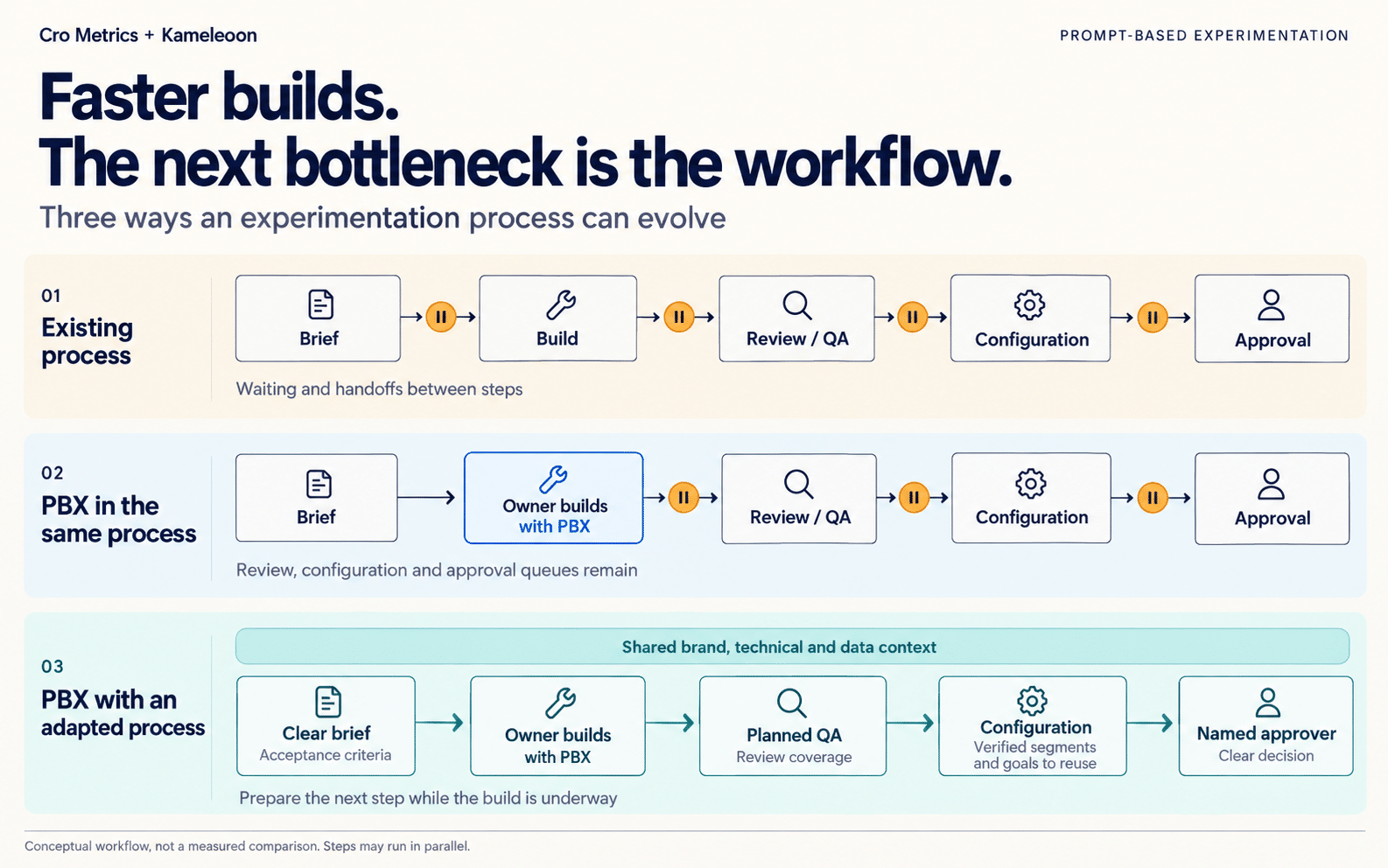
Three ways your process can evolve
| Workflow | What it looks like | The next opportunity |
|---|---|---|
| Your existing process | A brief passes through build, review, configuration, and approval, with waiting between steps. | Find out where active effort and queue time accumulate. |
| PBX within that process | The owner can create a variation more directly; existing review routines continue. | Capture the build benefit and identify the next delay. |
| PBX with an adapted process | Shared context supports building, reviewers receive clear criteria, and ready work advances. | Reduce repeated clarification and avoidable waiting across the workflow. |
This is a conceptual map, not a measured comparison. Teams may sequence work differently or complete steps in parallel.
Make the intended experiment clear
A retail strategist explained why a written brief still mattered even when the variation could be built through conversation.
“There’s still a nonzero amount of time where it’s going to be dependent on their targeting, or their exclusions, or some voucher code, that would need basically called out in the spec.”
Growth strategist · Retail accounts
Give everyone the same short reference: the hypothesis, intended behavior, pages, audience, success metric, and acceptance criteria. Use it to guide the prompt, review the result, and approve the setup. Update it when the idea changes. A good brief saves the team from rediscovering decisions at each handoff.
Make configuration easier to get right
In one session, “paid traffic” was used as a temporary audience description and resolved to search-engine traffic, which did not match the participant’s intent. The lesson is practical: define the intended audience precisely and inspect what the platform configured.
Reuse verified segments and goals where available. Current PBX documentation supports account-asset references and a configuration review before launch. Prepare those assets once, then make confirming scope, exclusions, and measurement part of the normal review. [3]
Helping the rest of the program keep pace
Build confidence through a familiar review process
Even when PBX did what they asked, some practitioners needed time to get comfortable with how easy the experience felt.
That reaction is understandable for someone accountable for what ships. A successful preview is encouraging; a review by someone who knows the site gives that success a firmer foundation. QA by humans before launch was a sentiment shared universally across our interviews.
Give that reviewer everything needed to assess the experiment together: the brief, preview, intended audience, affected pages, measurement plan, and known edge cases. Agree on review coverage that fits the change, and reserve time for it while the build is underway. PBX’s configuration review and simulation can support the process. [3]
Let design expertise travel with the build
Participants drew a useful distinction between changing an existing design and generating something new. They also saw value in bringing design-team work into PBX through Figma. This gives you a straightforward way to introduce AI-assisted implementation while keeping design direction deliberate.
Reuse approved conventions for familiar components. For new visual work, agree on the design inputs before building. Master Prompts can carry recurring instructions, and Figma frames can provide the visual reference. When reviewers repeatedly request the same correction, improve the shared context so the next builder benefits. [1, 2]
Give approval a clear question and an owner
A working preview is most useful when people know what they are being asked to decide. Does this experience implement the agreed idea? Have the relevant checks passed? Is it ready for the intended audience? Name the approver, collect feedback against a specific version, and record the decision in your existing system of record.
For suitable work, allow approval as soon as the requirements are met. If the process still requires a week of waiting after everyone agrees, you have found a habit worth revisiting.
Measure the gain you want to keep
Separate hands-on effort from elapsed time. Record the build, corrections, reviewer effort, and waiting between steps. Time to launch covers the path from the agreed starting point to release; time to learning also includes data collection, analysis, and the decision that follows.
These measures tell you what to improve next. You may need clearer instructions, a recurring QA slot, or fewer repeated entries across systems. Start with the delay you can see, make one adjustment, and check whether more work moves through confidently.
5 Your first experiment with PBX
You do not need to reconfigure your entire program before trying a different way to build. Start with one useful experiment. Give it enough structure to learn from the experience, then use what happens to decide how to expand.
Choose an idea you have wanted to move forward
Pick a real customer question with a clear proposed change. Look for something that has been waiting on implementation rather than on a decision about whether it matters. Confirm that the audience and measurement can support the question, and choose a scope your team can review.
Bring the people and context together
Write a short brief covering the hypothesis, behavior, pages, audience, primary metric, and acceptance criteria. Name the builder, reviewer, and approver. Gather approved copy or design inputs and the relevant account assets. Agree on when review will happen so the variation has somewhere to go when it is ready.
Build something you can respond to
Describe the intended change in PBX. Identify the element, desired behavior, and what should remain intact. Inspect the preview, explain specific mismatches, and refine it. Keep a simple note of hands-on time, corrections, and any specialist help. If progress stalls, involve a specialist with a clear description of the issue.
Review the experiment you intend to run
Check the experience against the brief, including the relevant devices and interactions. Review scope, audience, allocation, and goals separately from visual appearance. Use simulation and the appropriate specialist checks, then share the reviewed version with the approver. [3]
When requirements and platform setup are complete, launch under your team’s normal controls. Kameleoon distinguishes browser-based exploration from live testing, which requires its script on the site. If you are still evaluating the platform, a reviewed variation and a clear launch plan are useful first milestones. Count them separately from a live experiment. [4]
Use the experience to choose your next change
Compare the effort, waiting, and developer involvement with a similar recent task, labeling any estimates. Ask what became easier, what the team learned, and what would help the next experiment move further. Then repeat on another worthwhile idea. Follow launched experiments through the measurement plan to a decision.
Give one good idea a way forward
The most encouraging moment in these sessions was when a practitioner stopped wondering whether the tool could build something and started imagining what she could do with it. Bring one of your own ideas into PBX. See what becomes possible, involve the people who can help it reach launch, and use that experience to rethink the next part of your program.
Explore PBX and start a trial with Kameleoon
Product references
[4] What is Prompt Based Experimentation
Ready to turn ambitious growth goals into deeper customer connections and measurable business impact?
Reach Out Today