




When it comes to your “source of truth” for understanding the efficacy of your paid media investment, what do you
trust?
The ad platforms?
Google Analytics?
Shopify or whatever your transaction platform is?
Attribution has long been a
third-rail topic. Some paid media marketers have thrown up their hands and exclaimed it’s impossible to solve.
Others have invested heavily in Marketing Mix Modeling (MMM) solutions such as Rockerbox.
Your Data Sources Don’t Always Agree.
Anyone who has ever managed a paid media campaign has experienced this. Meta, Web Analytics, and your transaction
source of truth will likely provide wildly different answers.
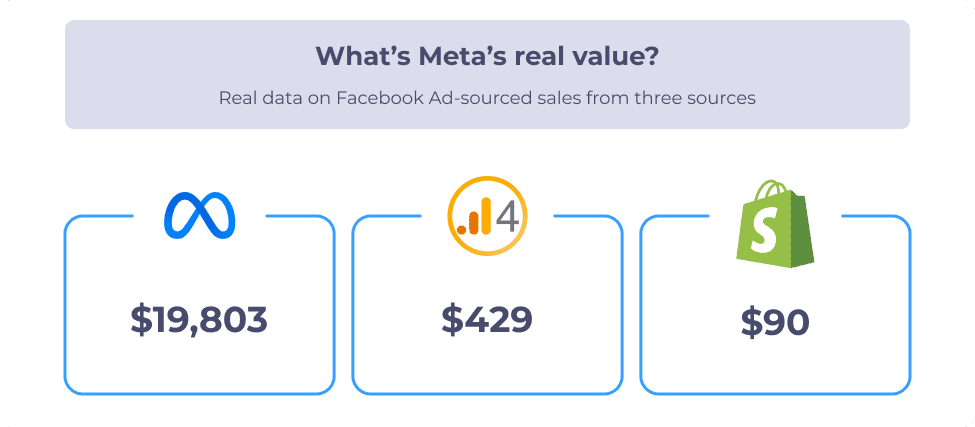
Why Don’t These Numbers Match?
Several reasons. The first is click-based attribution. First, Google Analytics and Shopify (for example) will only look
at click-based data, so unless people click on your ad, they won’t give credit to Meta.
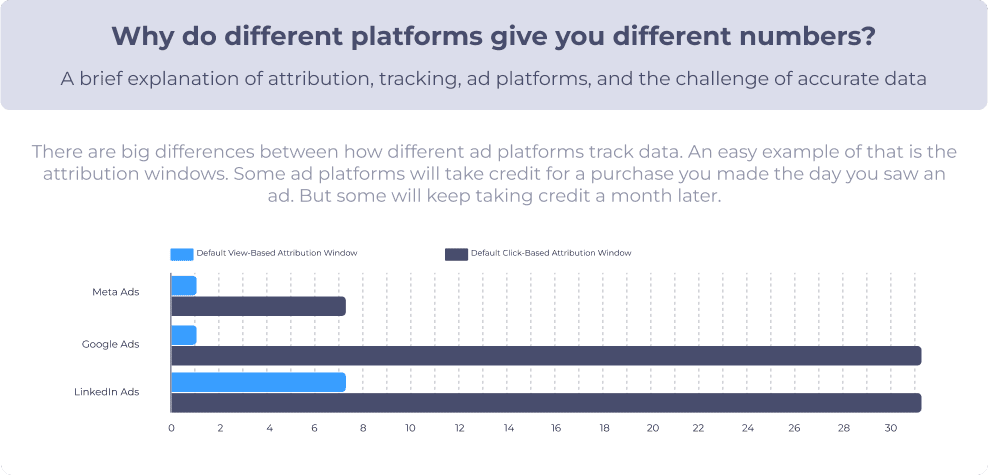
Meta employs a view-based attribution model, which means if a user has allowed Meta to track them and they
scroll past an ad on one of Meta’s platforms then purchases that product within 24 hours, Meta will take full
credit for the purchase.
But wait, it gets worse. LinkedIn will take credit via view-based
attribution if you saw an ad a week ago.
So, Should We Just Trust the Ad Platform Data?
No, because ad platforms use varying attribution models. In our own work managing and
optimizing paid media marketing programs for clients, we’ve seen vastly different numbers coming out of different
platforms.
Even Google Ads and Google Analytics don’t always agree. While the numbers won’t be as
distant as Meta vs. a last-click model, we’ve certainly seen big deltas here as well.
This is because ad platforms have differing
abilities to track conversions. For example, if one uses Google Chrome, Google has a pretty good sense
of that user’s activities across sessions. But privacy laws and technology such as GDPR and Intelligent Tracking
Prevention (ITP) make it exceedingly difficult to track visits across sessions and devices, and platforms like
LinkedIn or X (Twitter) lack the luxury of having their own ecosystem (like Chrome). Customer journeys are often
non-linear, and models often fail to capture the entirety of customers’ nuanced paths, including offline
interactions or word-of-mouth.
Further, Ad Platforms Calculate Conversions Differently.
If one views a Google Display ad, doesn’t click on it, but purchases the product
anyway (via some other path), Google Ads will take a fraction of the credit. As stated earlier, that same action for
a Meta ad has Meta taking 100% of the credit.
So, How Do You Know Which Ad Channel is Working?
Solely relying on the data that ad and web analytics report will affect the decisions
you make when trying to recognize what is effective.
If you look at your backend or Web Analytics exclusively, your data will heavily skew
in favor or click-based conversions.
That will influence you to allocate more budget into SEM, branded search, and ads
targeting existing customers, which won’t help acquire new customers.
If you look at ad platform data, it will skew in favor of those platforms that have
more generous attribution models, like Meta.
Which means you’ll run campaigns with uncertainty of knowing if you’re attracting
existing customers or acquiring new ones. You’ll have no way of knowing if those transactions were driven by an ad
or if they’re long-term customers persuaded by your last email promotion.
So, What Are the Options?
Some (retail) marketers have turned to tactics such as:
- Promo codes (by campaign)
- Incentives to click (e.g: “Click here to get 20% off”)
…but these have their downsides:
- Coupon code sharing
- Being forced into giving a discount for every ad
- Still having to wrestle with ad platform reporting inconsistencies
Our Solution: Multi-Touch Attribution with Validated View-Based Conversions.
We enable our paid media clients to overcome this struggle.
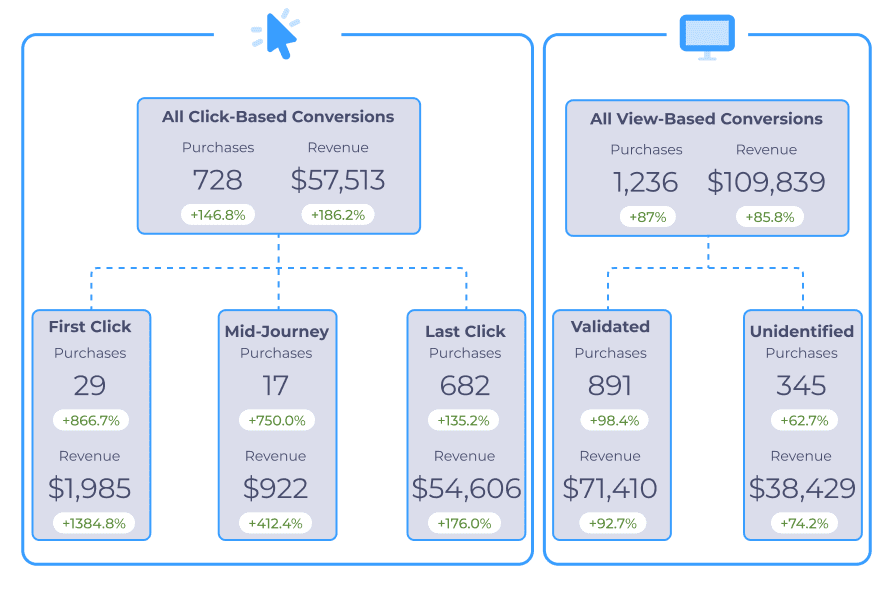
When it comes to view-based, we wondered, “can we actually validate what Meta is
telling us and match it to an actual purchase?” By using artifacts of the transaction data paired with the data
coming from Meta, we can validate which conversions Meta has directly contributed to.
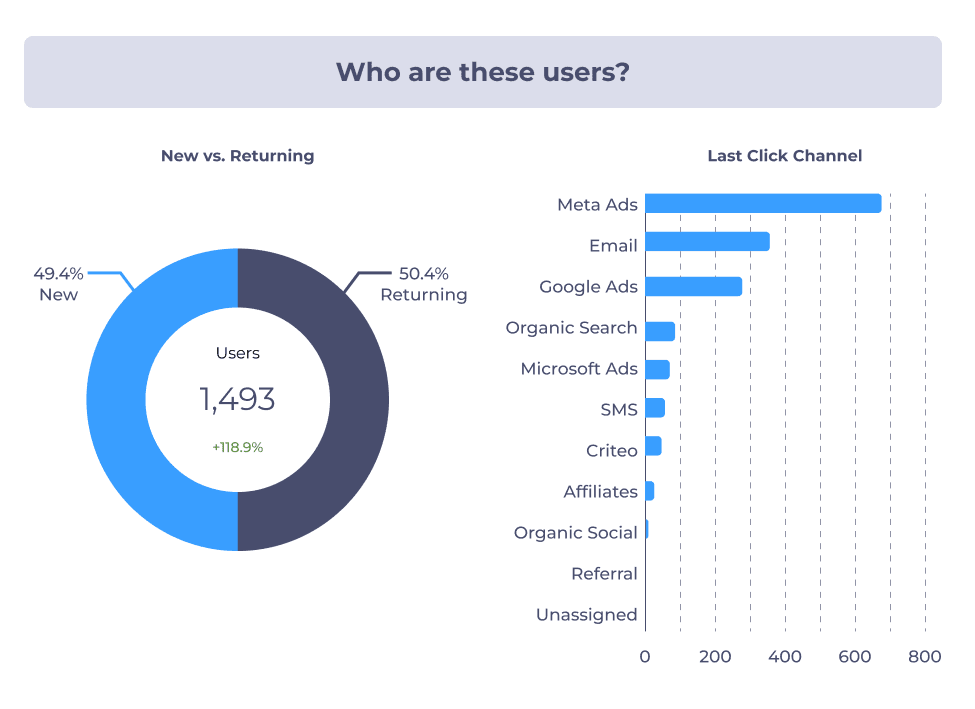
Then we suss out the big insights, such as whether these campaigns are targeting new
or existing customers, and how are they actually reaching the site (through email, organic search, or some other source).
…and work it into 5 different multi-touch attribution models that can be switched
between on-the-fly as we analyze the data.
Is it perfect? No.
As you can see above, there are some view-based conversions we can’t identify. Does
that mean Meta had no influence on those purchases? Not exactly, we just didn’t find evidence of it.
What we have achieved is greatly increased signal in the data, and we’re collecting
and processing data from multiple sources, including the transaction source of truth. This enables us to employ
attribution modeling that can be tailored to campaigns goals (top, middle or bottom of funnel for example),
providing a greater ability to truly assess where budget likely has the most (and least) impact. Not to mention, our
clients are no longer looking at apples to oranges on what constitutes a conversion.
Where Should I Start?
Ask yourself what the value of accurate data means for your business goals. With a low
monthly spend and limited channels it will be easier to see what’s working even with the discrepancies and varying
attribution models. But if your monthly spend is in the 5 to 6 figure and beyond territory, it’s worth allocating a
small percentage of that budget toward accurate analytics to have a true assessment of customer acquisition cost by
channel, campaign, and even down to ad creative levels. With simply a few key decisions on where to double down and
where to cut wasteful spend, that small allocation has the potential to tenfold your investment.
If our message on better informed and actionable paid media attribution resonates with
you, please send us an email at dave@crometrics.com and tell us why. Our continued improvements of attribution
modeling for our paid media clients has enabled significant growth across diverse industries. We’d appreciate the
opportunity to learn more about your business and explore how we may help reach your business goals.
Ready to turn ambitious growth goals into deeper customer connections and measurable business impact?
Reach Out Today